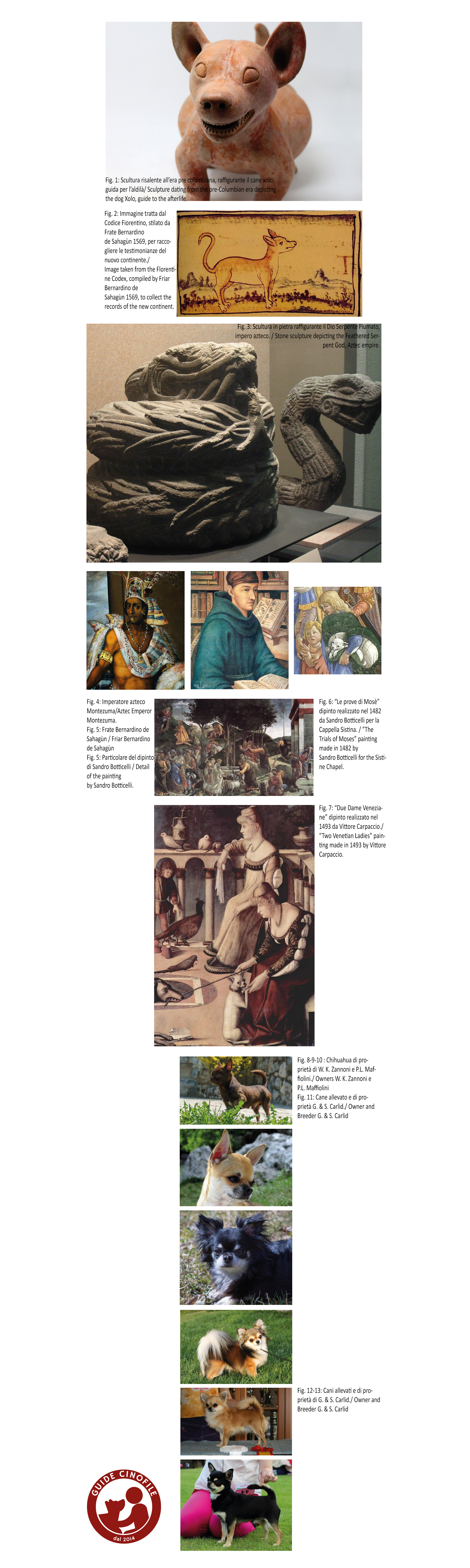
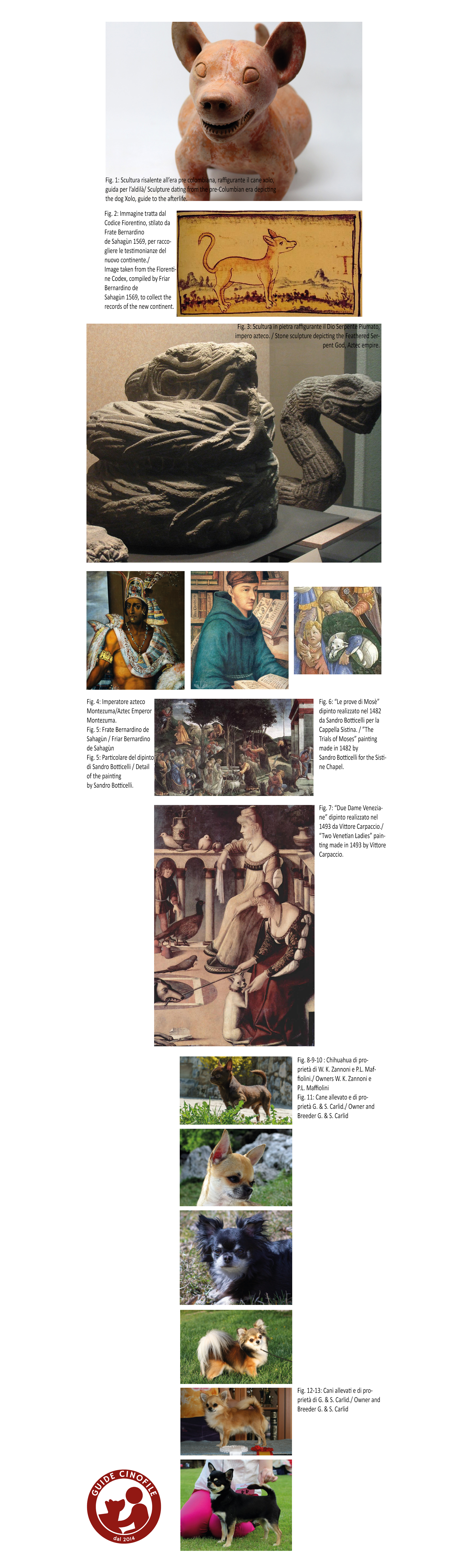
CHIHUAHUA
A grand little dog with a thousand-year history?
Alfonso Montefusco
Great, with history thousands of years old as well, but with implications that will make us think bigger, precisely as is characteristic of this little dog’s personality!
We are in the southern part of North America, where the Mexican Federal Republic is, comprising no less than 31 states today. Although Mexico is known for its beaches overlooking the Pacific Ocean and the Gulf of Mexico, the state of Chihuahua
is untouched by the sea, being nestled north on the U.S. border across the deserts of Texas and New Mexico, east with the state of Coahuila and west with the state of Sonora. It is Mexico’s largest state, with a territory almost equal to the entire peninsula of Italy and perhaps the only one that owes its worldwide fame thanks to a dog that bears its very name: Chihuahua!
Walking around the capital of the same name, which has more than 850,000 inhabitants, among many details that lead back to the history of ancient peoples, it is also possible to come across giant photographs of little Chihuahua, a great canine
ambassador of the culture of these places. Let’s go back many centuries to the pre-Columbian civilizations.
We can discover the millennia-old roots of the civilizations of that period, which settled after the departure of the well-known Mayan communities consisting of great architects, mathematicians and astrologers. Even today, several scholars question how they could
design temples and cult sites strictly about the topography of our solar system’s planetary constellations without the technological instrumentation we have today. Indeed, it is a mystery when discussing work done almost 3,000 years ago. Even more mystery
lies behind their departure, which left room for the communities of the Toltecs, a nomadic population of scientists and warriors who fused their cultural roots with those of the Maya, enriching excellent spiritual knowledge.
Although these adherences have allowed the great fascination that hovers around the fairy tale history of the Chihuahua, ancestor of the dogs of the Mexican Toltec peoples, dutifully, archaeologists and local guidebooks point markedly to the presence of animals present in villages, often for practical purposes. Still, the dog was never dominant or an elected commensal, except in sporadic social classes. Some treatises describe small-sized dogs with semi-long hair called Techichi, also depicted in some statuettes and bas-reliefs in temples and drawings. They are very reminiscent of the features of the small dog we know today, but asserting that they are our Chihuahua ancestors is somewhat debatable and unprovable. And it can also be asserted that they may be small-bred mammals rather than dogs.
In any case, the dog had a special relationship with esotericism; it was elected to be a messenger from the world of the dead and a protector against evil spirits. They were used, along with other animals, both for religious rituals and sacrifices to the various deities that dominated the religions of the time, but also as a food resource.
But returning to the fate of the Toltecs, it was destined to be short-lived, supplanted by the rapid rise and merger of the Aztecs, who gained more and more space from 1200 CE onward, absorbing the occupied areas’ customs and traditions. The Techichi dogs came into the good graces of the Aztec aristocracy, thanks partly to Emperor Montezuma II Xocoyotzin, under whom the empire peaked. The last incarnation of the mythical Plumed Serpent, a deity firmly rooted in those territories for millennia, was Quetzalcoatl, a kind of messiah and medicine man who, in his existence, had greatly influenced collective thinking, succeeding in fighting to end the aberrant custom of performing human sacrifices for good.
Before he disappeared, he predicted that he would return to bring salvation and wisdom, progress and innovation. When, by 1492, the Spanish and Portuguese conquistadors had come to conquer the new continent, most interpreted them as the return of the Feathered Serpent deities bringing salvation. This belief made the local natives vulnerable as European intentions were anything but friendly and cross-cultural dialogue. They wanted to appropriate the place and enslave as much labour as possible. The excuse was always the same: contribution of culture, knowledge, civilization, and salvation through our Lord, the God of Christianity.
The emperor tried to build a partnership with the colonizers but was unfortunately killed. The upheavals of those years resulted in the loss of many resources and traces related to the dogs of the time.
Still, we are sure that the Portuguese and the Spanish had brought with them the ancestors of the small Puerto Rican podengui and the Valencian ratonero. Dogs that most likely laid the foundation for the Chihuahua to be created.
All we know ends in the mid-1500s thanks to the writings of Franciscan Father Bernardino de Sahagun, who also reports the presence of small, tawny-coloured, often naked dogs accompanying local people. The influence of naked dogs often returns, which have no reason to be believed to have originated in Central America but arrived from Asia through the movements of nomadic peoples in the pre-Maya period. Other hypotheses consider the possibility of unforeseen inborn mutations in the canine gene pool worldwide, thus potentially present on every continent.
Many interpretations have arisen about the actual capabilities of chroniclers of the past in objectively recounting what they encountered; if we think of Christopher Columbus, who, after discovering the island of Cuba, wrote in his letters to the King of Spain about Opossums as small, domestic dogs that do not bark and are capable of climbing trees, it gives us a lot of insight into the European animal husbandry culture of those years, which did not yet foresee the existence of species other than the known ones, thus altering the credibility of the accounts. After all, Charles Darwin would not be born until almost three centuries later!
In the meantime, History tells us that while all this was happening on the new continent, Europe was going through a period of consolidation of states and governments, had banished the spectres of the Middle Ages of previous centuries, overcoming plagues, famines and an unusual global climate warming similar to what we are experiencing today. It was 1543, and Nicholas Copernicus had published “The Revolutions of the Celestial Stars,” Small dogs brightened the days in royal courts and upper-class drawing rooms. But even earlier works by various artists, among which we highlight those by Sandro Botticelli in the Sistine Chapel in 1482, there are small dogs carried in bags, very similar to whattoday is the Chihuahua. This makes us think of the real possibility of tiny dogs’ presence throughout Europe, the ancestors of the English Toy Terrier Black and Tan in Britain or the continental
dwarf Epagneul in France.
Without dispelling a myth of purely Mexican origin, it should be kept in mind that size reduction in the domestic dog has undoubtedly taken place everywhere in the world, biologically involving a morphological modification that causes those typical features of the cranial bones and the positioning of the eyes to be expressed; thus, those neo-technical features that we find in dogs such as the Chihuahua for example. After American independence from the British Empire, the presence of small dogs from the Mexican border resurfaced. The United States was the first to become interested in small dogs, dating back to crosses during the 18th century between native dogs and dogs imported by Europeans.
In 1884, we had the first record at a dog show in Philadelphia of a small dog exponent of a type called the “Chihuahua Terrier”.
It was 1904, and his name was Midget, the first Chihuahua to be entered in the Genealogical Books of the American Kennel Club, decreeing from that moment the rise of a breed that originated in the Mexican territories and recovered thanks to the skilful work of American cynophiles and breeders.
In 1923, the U.S. club was founded thanks to a group of passionate breeders, including Ms. Ida Garret, a journalist and breeder, who worked for more than half a century to select the ideal type of Chihuahua. The drafting of the Standard was no simple matter, especially agreeing on different views about tail carriage or ear shape.
In 1952, the AKC decided to officially divide the two coat varieties, short and long, that had always been present in the breed’s recent history.
Of course, trade and diplomatic exchanges with Great Britain allowed the first Chihuahuas to reach across the Channel, garnering the breed’s slow but growing enamour. In 1906, the first exponents of the breed, the result of generations of dogs imported from the United States, were exhibited at the Richmond show.
Despite the great enthusiasm and interest in breeding these dogs, the two world wars brought a significant slowdown, with the need to resume breeding and retrieving subjects after World War II. In 1949, the first British club was founded to protect the Chihuahua,
pointing to a type that stood apart in certain morphological traits while preserving that salient personality expressed in the disruptive temperament.
Soon, the Chihuhua’s success conquered the entire world, spreading to every nation, partly due to its unique peculiarity in the canine world, its tiny size, and partly due to the millennia-old, somewhat fairy-tale-like and fascinating history surrounding it. Of course, not the least of which was the character of an army general!