ILLUSTRIOUS WOMEN
Interview with Ana Mesto
Victor Platia
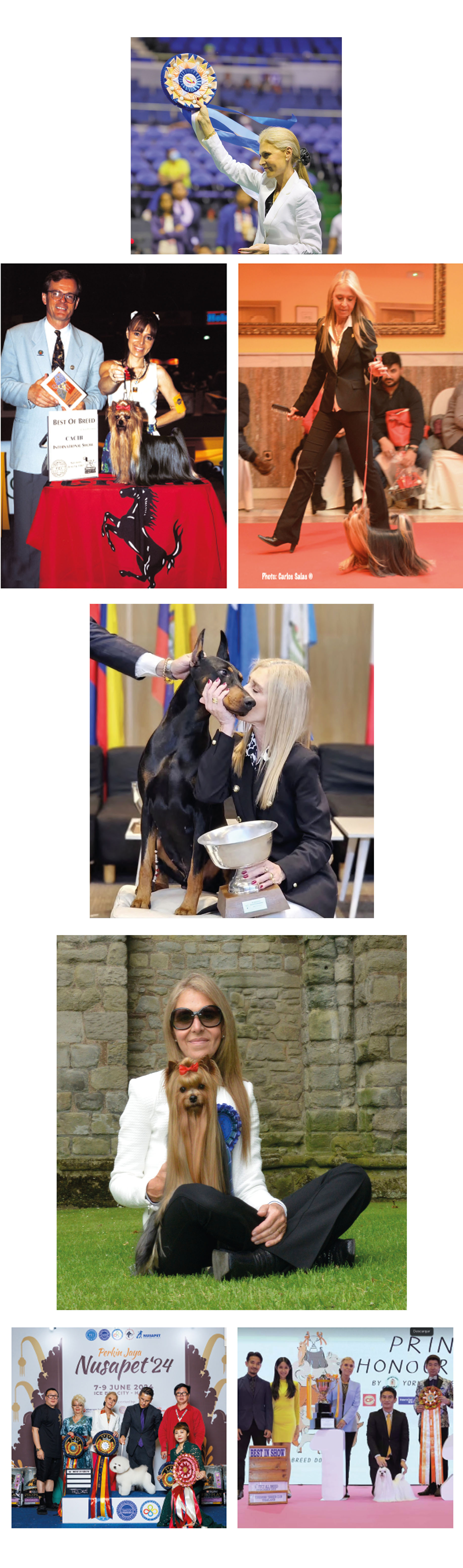
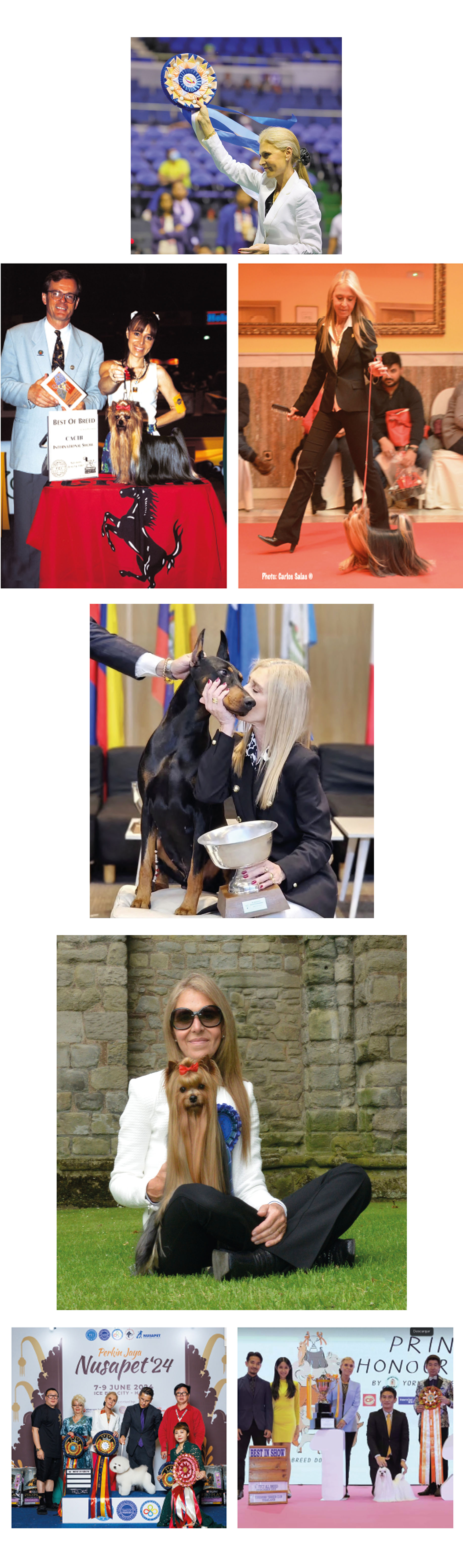
Always passionate about nature, dogs have always been her lifelong companions. She began breeding Dobermanns and from the start demonstrated her quality as a dog enthusiast. Together with her husband Carlos Salas, in 1988 they founded the Yorkshire kennel La Villa y Corte, obtaining more than 250 titles worldwide, author of “el nuevo libro del Yorkshire” and director of various dog magazines. Together with her dear friend Carmen Navarro, she is one of the only two female all-rounder judges in Spain. A true leading woman in the world of dog breeding.
I would like to know about your beginnings: how did you enter the world of dog breeding, did your family breed or were you the first to become passionate about dog breeding?
Since I was a child, I have always been passionate about dogs, even though my family did not agree to keep one, let alone breed them. It was during my adolescence, after much insistence, that the first dog entered our home, an Afghan named “Huilaco’s Párrafo,” a gift from my friend and breeder Norman Huidobro. “Párrafo” immediately captured everyone’s love, and from that moment on, there has always been an Afghan as the family companion dog.
We know that you have bred various breeds before discovering your true passion: Yorkshire Terriers; can you tell us something about this wonderful journey from Dobermanns to your current breed. My relationship with organized dog breeding began in 1980, when I started breeding Dobermanns while studying architecture.
In 1981, at the 1st Dobermann Club de España Specialty Show, the first Clubsieger, corresponding to the male Puppy class, was a dog bred and presented by me, the result of my first litter, with the judge being Herr Hans Wiblishauser, president of the International Dobermann Club and the most recognized and prestigious judge of the breed.
Together with my husband Carlos Salas, we have bred German Shepherds, Spanish Mastiffs, Catalan Sheepdogs, Pachón Navarro, Pointers and, with greater dedication, Miniature Schnauzers (we have obtained several champions, including world championships) and Yorkshire Terriers, a breed to which we have dedicated ourselves for 32 years with the “La Villa y Corte” kennel.
With the Yorkshire Terrier we have achieved remarkable successes and a multitude of championships (over 350) in countries in Europe, America, and Asia. Among these, several World Championships (with three consecutive generations of WW) and several European Championships. We have won the Yorkshire Terrier Club National in the United States five times, with different dogs.
We won BOB and RBOG at the Japan Kennel Club Centenary Show in 1999. In 2016 and 2018 we had the enormous privilege of winning Best of Breed at Crufts, the largest and most important show in the world, with our Multi BISS & BIS, Multi Ch. “Red Bull de La Villa y Corte”, who also won Best in Show at the Breed Show held in Yorkshire (England) in 2016, completing his United Kingdom Championship.
Is there a breed you would have liked to breed?
Yes, the Afghan Hound, actually this is my favorite breed along with the Yorkshire.
One day your career as a judge began; at the beginning, did being a woman make the path more difficult?
I wish I could say that it wasn't like that, but that wouldn't be true. At the beginning it was very difficult and expensive, with many obstacles, but I am a Capricorn and I always achieve the goals I set for myself and today I am one of the only two women who have managed to become all-rounders in Spain.
To date, you have judged almost all over the world and are recognized worldwide. Which exhibitions have left a mark on your memory, can you share some anecdotes?
Actually, I consider every exhibition a positive experience, but if I had to choose a few, the exhibitions I appreciated the most are EURASIA, in Russia, for their excellent organization and exhibition spaces. The circuit in the Philippines surprised me a lot, again for the hospitality, not only towards the judges but also the respect for the dogs and exhibitors, with free transportation for everyone who needed to move from the airport to the hotel, offering different types of comfort, with attentive and helpful staffthroughout the entire exhibition, to solve any unforeseen event, question, or doubt.
Besides your own breed, which other breeds do you prefer to judge?
Definitely the Yorkshires and the Afghans, but I have a lot of fun especially judging group 9, 10, and group 3.
What do you consider most important when judging a dog at a show? Some judges prefer functionality, others the type. What do you look for in your ideal subject?
For me, the fundamental aspect is the TYPE; I want to look at the dog and recognize that it brings together all the characteristics of the breed, so that I can say, this dog belongs to this breed. After that, I move on to the detailed evaluation and comparisons. The TYPE is exactly the expression of functionality. Both things are fundamental, and based on these, the standards have been drawn up.
How do you see cynology at the European level today, especially compared to what it was when you started?
Today I see cynology resigned, and this really makes me very sad. We have allowed animal rights movements to take over without reacting.
Pedigree dog breeding is constantly under attack without reacting with adequate strength. The old breeders fought much more and defended their breed tooth and nail, and for this reason pedigree dog breeding has endured for centuries. But this only until today: what they defended with strength, we are letting the animal rights activists take away from us.
Do you think the quality of purebred dogs today is lower, and if so, what do you think might be the reason?
It depends on the breed. There are breeds in which the level has dropped significantly (for example in the Yorkshire), there are others in which the past standards are maintained, and others in which a very high level has been reached. The reasons are different; in the specific case of the Yorkshire, the crosses with Shih Tzú to obtain the Biewer had a big impact. These crosses caused a radical change and the destruction of the traditional Yorkshire.
Generally, the quality of a breed varies according to its popularity: the pattern always repeats in the same way. A breed becomes popular, a great competition begins, quality increases, the market becomes saturated with inexperienced breeders who are only looking for financial gain, and quality decreases. Breeds that maintain steady popularity over time are those that maintain the best quality.
We have recently been experiencing a decrease in the number of dogs at shows, what is your opinion on this? What do you think might be the cause?
I believe that fundamentally the decrease in the number of dogs depends on three main reasons:
1) The large number of exhibitions. The cost of living has increased significantly in recent times: meals, hotels, fuel, registration fees, etc., and exhibitors are unable to participate in all the shows and are forced to make a selection.
2) Another problem is represented by the terrible influence of animal rights activists. There are countries, for example Germany, in which the conditions required to participate
at an exhibition (non-accepted breeds, excessive health checks, grooming checks, etc.) lead exhibitors to give up participating.
3) How the exhibitor is treated. The exhibitor is the KING of the show; without exhibitors there are no dogs and without dogs there are no shows. The organization, the judges, the exhibition venues, are all useless without the exhibitors. For this reason, they must be pampered, everything should be made easy for them, and they should be offered professional, respectful, and kind judges. In short, they must be given valid reasons to decide to invest their time and money to attend the shows. Unfortunately, many organizations do not think this way and I believe that, starting from the ban on cropped ears and tails in all FCI countries, entries will continue to decrease.
In addition to being passionate about cynology, I know that you have experience editing various dog magazines. Do you think we still have a chance to continue printing on paper or do you think sooner or later the time will come when everything will be online? I ask you this as someone who goes against the tide.
As a publisher, I can tell you that smelling and touching printed paper is absolutely irreplaceable, the brilliance and sharpness of a printed photograph is unmatched, and devouring a text on paper cannot be compared to reading on a screen. The proof is that literature continues to be printed, books continue to exist, and I want to believe that even printed dog magazines can continue and be produced for many more years. Obviously, we cannot expect the same regularity as in the past, also because in today's world it is essential that results are available in real time, and this can only be achieved through the internet. Therefore, today's magazines must have a more general approach, with timeless or broad information and interesting, varied, and original articles. I know from personal experience that the economic cost is very high, but with good management I believe it is feasible.
Ana, I would like to thank you for the time you have given me. It is always a great pleasure to be able to talk with you and I hope it was pleasant for you as well. Many thanks from myselfand all the readers of SUPREME DOG SHOW.
It was a pleasure talking with you and knowing that there are still people so interested in cynology who dedicate all their efforts, even financial ones, to this. I know it is not easy, but I am sure that with your efforts and tenacity you will achieve great success.
I wish SUPREME DOG SHOW a very long life.